Cart
No products in the cart.

Your feet do not care what the foam is called at 8 a.m. They care about how the shoe feels after a long shift, a school run, or mile six. That is how to compare sneaker cushioning without getting lost in brand talk: focus on the feeling underfoot, the support around it, and the job you need the shoe to do.
A thick midsole can feel amazing for ten minutes and sloppy by lunchtime. A firmer shoe can feel boring indoors but keep your legs happier on a long walk. There is no single “best” cushioning. There is only the cushion that makes sense for your day.
Before comparing foam, be honest about your mileage and your routine. Are you standing on tile for eight hours? Walking the dog twice a day? Running three easy miles a few times a week? Or mostly wearing sneakers with jeans and wanting your feet to stop complaining?
For long days on hard floors, soft cushioning usually feels better at first. Shoes in the Hoka Bondi or Brooks Ghost Max lane are built for that plush, protected feeling. They can be a solid pick when your feet feel beat up from standing. The trade-off is that a tall, soft shoe can feel less connected to the ground and a little awkward if you move quickly side to side.
For everyday walking, look for balanced cushioning. You want enough foam to take the edge off pavement, but not so much that every step feels wobbly. Models such as the New Balance 1080, On Cloudrunner, or many Asics Gel options can land in this middle ground, depending on the version.
For running, the answer depends on pace, distance, and what you enjoy. New runners often assume softer is always safer. We disagree. If a shoe feels unstable or makes your stride feel strange, extra softness is not helping. A medium-soft shoe with a smooth ride is usually easier to live with than a marshmallow under your heel.
Every brand has a name for its midsole material. Some are soft and bouncy. Some are firm and springy. Some use air units, gel inserts, or pods. Those details can be useful, but they do not tell the whole story.
When comparing shoes, pay attention to four things: softness, rebound, stability, and protection. These are different. A shoe can be very soft but have little rebound. It can be firm but still protective. It can feel bouncy in the store but become tiring on a long walk.
Soft cushioning compresses easily when you step down. It takes the sharp edge off concrete and can feel great when you are tired. If you work on your feet, this is often what you notice first.
But very soft shoes are not automatically more comfortable. If your foot sinks too deeply into the foam, your ankles may have to work harder to stay level. That can be fine for straight-line walking. It may be less fun on uneven sidewalks, stairs, or busy days when you are turning constantly.
Pressing the midsole with your thumb tells you almost nothing. Wear the shoe and walk. Your body weight, stride, and foot shape matter more than a finger test.
Rebound is what happens after the foam compresses. Does the shoe feel like it gives a little energy back, or does it just absorb the impact? Neither is wrong.
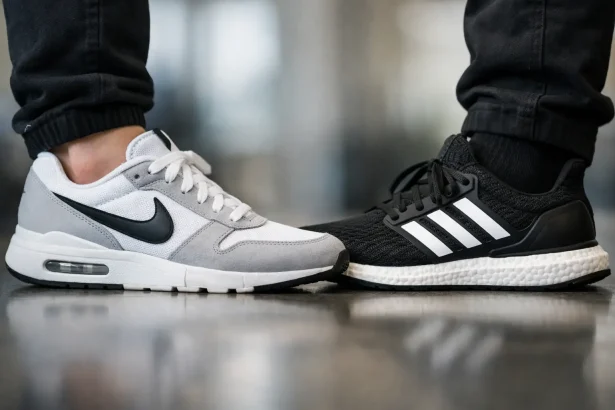
A lively ride can make easy runs and brisk walks feel less flat. Nike models with responsive foam often lean this way, while some Adidas and Puma sneakers may feel firmer and more direct. A calmer, less bouncy ride can be better when you want steady comfort instead of a spring under every step.
Do not confuse rebound with speed. A bouncy shoe will not turn a casual walk into a race. It may simply make your steps feel more energetic. If that feeling annoys you after five minutes, trust that reaction.
Stability is where a lot of people make a bad call. They buy the softest, tallest shoe available, then wonder why it feels sketchy around corners.
Look at the base of the shoe. A wider platform generally gives you a more planted feel. Also notice whether the upper holds your heel securely and whether the midsole walls rise around your foot. Those small details can make a soft shoe feel much more controlled.
If you know you tend to roll inward, or you just prefer a guided, steady step, consider shoes designed with added support. The Asics Gel-Kayano and Hoka Arahi are popular for a reason. They are not the flashiest shoes on the shelf, but they make sense for people who want less side-to-side movement. We would take stable and slightly plain over soft and unstable for an all-day shoe every time.
Protection is not only about stack height, meaning the amount of material between your foot and the ground. It is also about how the shoe spreads impact across the foot.
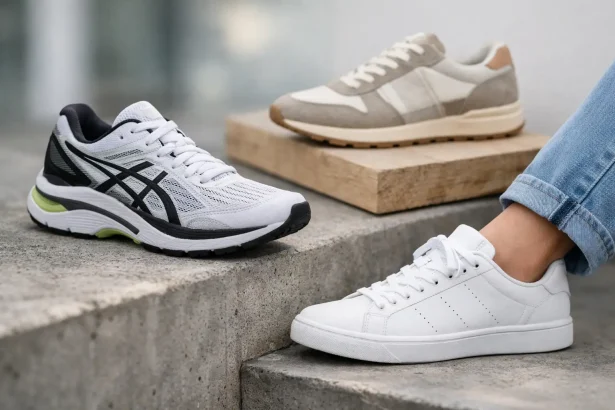
A thinner sneaker like an Adidas Gazelle or Puma Speedcat can look sharp and work well for short errands, driving, or casual wear. For a full day on concrete, though, flat lifestyle shoes are often a rough choice. If your feet, knees, or lower back are already sore from standing, skip the flat ones. Save them for days when you are not covering serious ground.
Cushioning only works when the shoe fits correctly. A soft shoe with a cramped toe box will still feel bad. A thick midsole cannot make up for a heel that slips or an upper that presses on the top of your foot.
Try sneakers later in the day if you can. Feet often swell after walking and standing, so a morning fit can be misleading. Wear the socks you normally use. Leave about a thumb’s width in front of your longest toe, but do not size up so much that your foot slides forward.
Then walk on a hard surface for a few minutes. Notice your heel first, then your forefoot. Does the shoe bend where your foot bends? Does your heel stay put? Does the arch feel supportive, or does it feel like a hard lump in the wrong place? A shoe should not need a painful break-in period to become tolerable.
Also consider weight. More cushioning usually means more material, and more material can mean a heavier shoe. For a work shoe, a little extra weight may be worth the comfort. For running, a heavy shoe can feel like work if you prefer a quicker, lighter stride. The right balance is personal.
If you are deciding between two pairs, do not compare them while sitting down. Put one on each foot. Walk around. Switch them. Your brain notices differences faster when both shoes are in the test at once.
Ask yourself a few plain questions. Which pair feels better when you land on your heel? Which one feels more stable when you turn? Which one leaves room for your toes? Which one would you choose if you had to wear it through a full grocery run right now?
Avoid judging by the first soft step alone. Spend at least a few minutes walking. A shoe that feels plush can also feel slow, hot, narrow, or unstable once you move naturally. The better choice is usually the one you stop thinking about because nothing is rubbing, pinching, or fighting your stride.
You do not need a massive max-cushion shoe for every situation. You may want one soft pair for work and long walks, then a lower, cleaner sneaker for casual days. That is not overbuying if both pairs get worn for the right reasons.
At The Sneaker Base, we think comfort should be practical. A shoe can look good and still do a real job. But if you are buying one pair to handle long days, choose the ride first and the color second. Black foam looks fine. Sore feet do not.
The real test is simple: picture the last hour of your day, not the first five minutes in the mirror. Pick the cushioning that still feels good then.