Cart
No products in the cart.
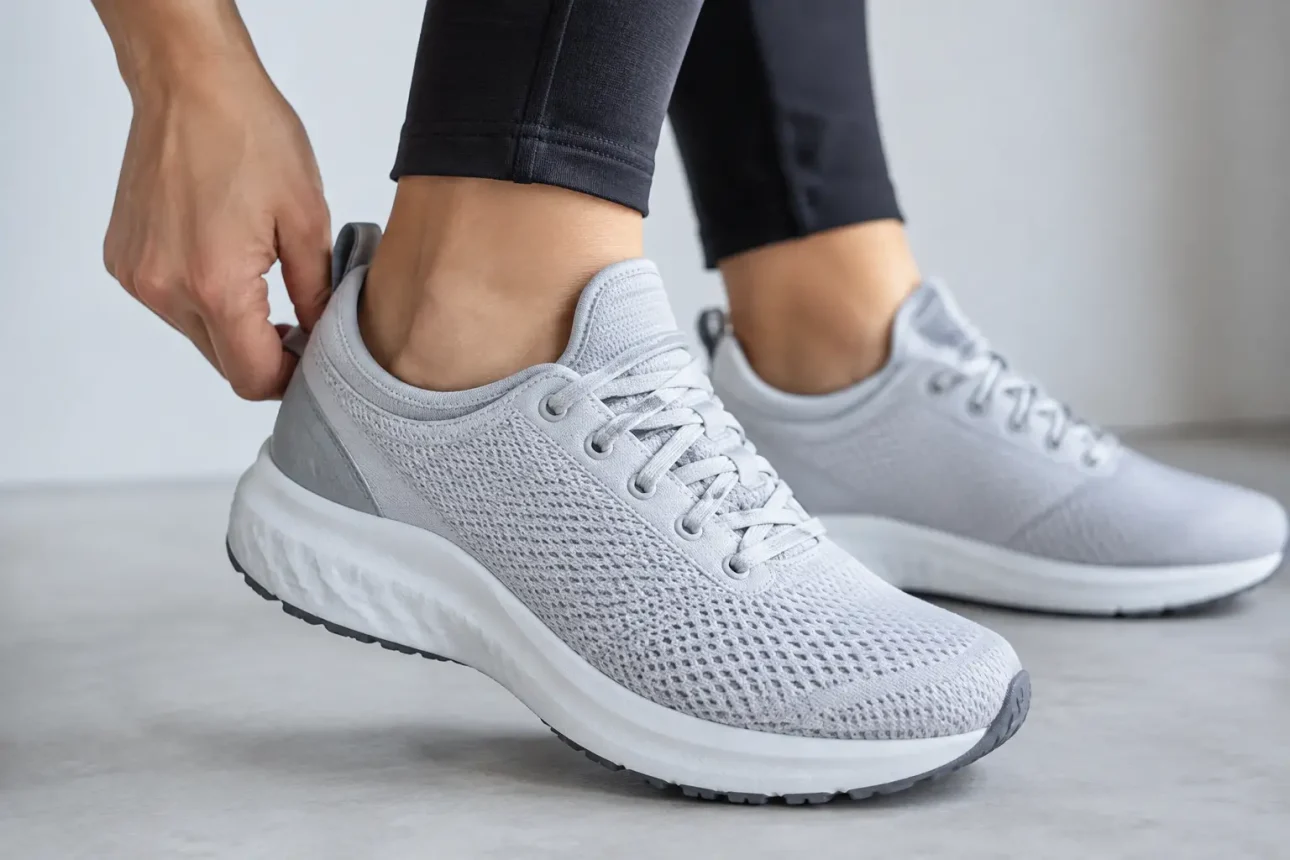
Your heel should not be lifting out of your shoe every time you walk. To stop heel slipping sneakers, start with the boring truth: the shoe may simply be too big, too wide at the heel, or shaped wrong for your foot. You can try a few easy fixes first. But if you are constantly gripping with your toes to keep the shoe on, do not talk yourself into keeping a bad fit.
A little movement can be normal in a brand-new pair, especially with a padded running shoe or a stiff heel collar. Actual slipping is different. Your heel rises enough to rub, your sock gets dragged down, or you hear that annoying squeak with every step. That is where blisters start, and nobody needs that on a walk to work.
Before you buy inserts or pull the laces tight, check whether the length is right. Stand in the sneakers with the socks you normally wear. Your longest toe should have about a thumb’s width of space at the front. Less than that can mean your toes hit the end on downhills. Much more than that gives your foot room to slide forward, which often makes the heel lift.
Length is only half the story. Some people have narrow heels and a wider forefoot. Others have a high instep, so they loosen the whole shoe to make room across the top. That creates a loose heel even when the toe area feels fine. A sneaker can also be the correct size on paper and still be the wrong shape for you.
Pay attention to the heel counter, which is the firmer cup around the back of the shoe. If it feels shallow or bends away easily, it may not hold a narrow heel well. Soft lifestyle sneakers are often the main offenders. They can look clean and feel fine for ten minutes, then start sliding around once you have walked a few blocks.
Try this test at home on a clean floor: lace both shoes normally, walk up and down stairs, then take a brisk five-minute lap. If your heel lifts more than a small amount on each step, do not expect a long walk or work shift to somehow fix it. Shoes usually loosen with wear. They rarely tighten themselves up.
The best free fix is a heel-lock lace, also called runner’s loop lacing. It gives your ankle more hold without crushing the front of your foot. This works especially well on running shoes, walking shoes, and most athletic sneakers with an extra top eyelet.
At the top two eyelets, lace each end straight up into the eyelet on the same side. Leave a small loop on both sides. Then take each lace end across the shoe, pass it through the loop on the opposite side, pull evenly, and tie as usual. The crossed lace tightens around your ankle and pulls your heel back into the heel cup.
Do not yank it as hard as you can. The goal is secure, not numb. If your toes tingle, the top of your foot aches, or you get a deep lace mark after an hour, back it off. A heel lock should keep the rear of your foot planted while the rest of the shoe still flexes naturally.
If your sneakers do not have an extra eyelet, you can still improve the hold by snugging the final two rows of laces a little more than the middle rows. Keep the lower laces comfortable across your forefoot. Tightening every eyelet equally is how people end up with sore feet and still-slipping heels.
Thin, worn-out socks create more room inside the shoe. If you usually wear athletic socks but tried the sneakers on barefoot or in dress socks, the fit test was never real. A medium-cushion sock can take up just enough space to stop minor slipping.
This is not a fix for a shoe that is half a size too big. It is a sensible adjustment for a fit that is already close. Avoid piling on two pairs of socks. Your foot will get hot, cramped, and more likely to slide once sweat builds up.
Heel grips, heel pads, and insoles can help, but they are not magic. We like them for a sneaker that fits well everywhere except for a little extra room at the back. A suede or foam heel grip sticks inside the heel collar and reduces the gap behind your ankle. It is cheap, simple, and worth trying before you give up on a nearly right pair.
The trade-off is rubbing. A thick or badly placed heel grip can create a hard edge right where your skin moves. Put it high enough in the heel area to fill space, not low where it catches your heel. Wear the shoes around the house first. If it feels scratchy in five minutes, it will feel worse after five miles.
A slightly thicker insole can also reduce slipping by lifting your foot into a more secure position. That can be useful if the shoe feels roomy throughout, not just at the heel. But lifting your foot also reduces space over the top of it. If your toes feel crowded or the tongue presses into your instep, take the insole out. Do not force it.
Tongue pads are another option for people whose feet slide forward because the shoe is loose over the instep. They stick beneath the tongue and add a little volume. They are useful, but only when that upper space is the real problem. If the heel cup itself is too wide, a tongue pad may not do much.
There is a point where fixing becomes fiddling. If you need thick socks, a heel grip, an extra insole, and painfully tight laces just to make a sneaker stay on, that sneaker does not fit. Return it if you can.
Skip the “they just need breaking in” line when the problem is heel volume. Breaking in may soften materials and reduce stiffness. It will not make a wide heel cup narrow enough for your foot. In fact, a soft collar can pack down over time and let your heel move even more.
You should also return or size down when your heel slips and your foot slides forward enough that your toes hit the front. That is not just annoying. On long walks, it can leave you with bruised toenails, hot spots, and a bad mood before lunch.
Sizing down is not always the answer, though. If the smaller size squeezes your toes or pinches the sides of your forefoot, do not buy it. You likely need a different model, a narrower width if available, or a sneaker with a more structured heel. The right shoe should hold you at the back without asking the front of your foot to suffer for it.
If heel slipping happens to you often, shop with the back of the shoe in mind. Look for a firm, well-padded heel counter and a collar that wraps around your ankle instead of flaring outward. Running and walking models often do this better than flat casual sneakers because they are built to stay put during repeated steps.
That does not mean every performance shoe will work. Some have very soft, roomy uppers designed for easy comfort. Nice for swelling feet or wide feet. Not so nice if your heel is narrow. When trying a pair on, press the heel counter, check how deep the cup feels, and walk before deciding. A soft foam sole can feel amazing standing still while the upper does nothing to keep your foot centered.
For work, errands, and long city walks, we would take a slightly less flashy sneaker that locks your heel in over a loose pair that looks sharp on the shelf. What matters is how your feet feel at 5 p.m. A shoe should let you move without thinking about it.
Start with the heel-lock lacing method and the socks you normally wear. If that solves a small amount of movement, you are set. If it does not, be honest about the fit and move on. The right sneakers do not need a whole rescue plan to stay on your feet.