Cart
No products in the cart.
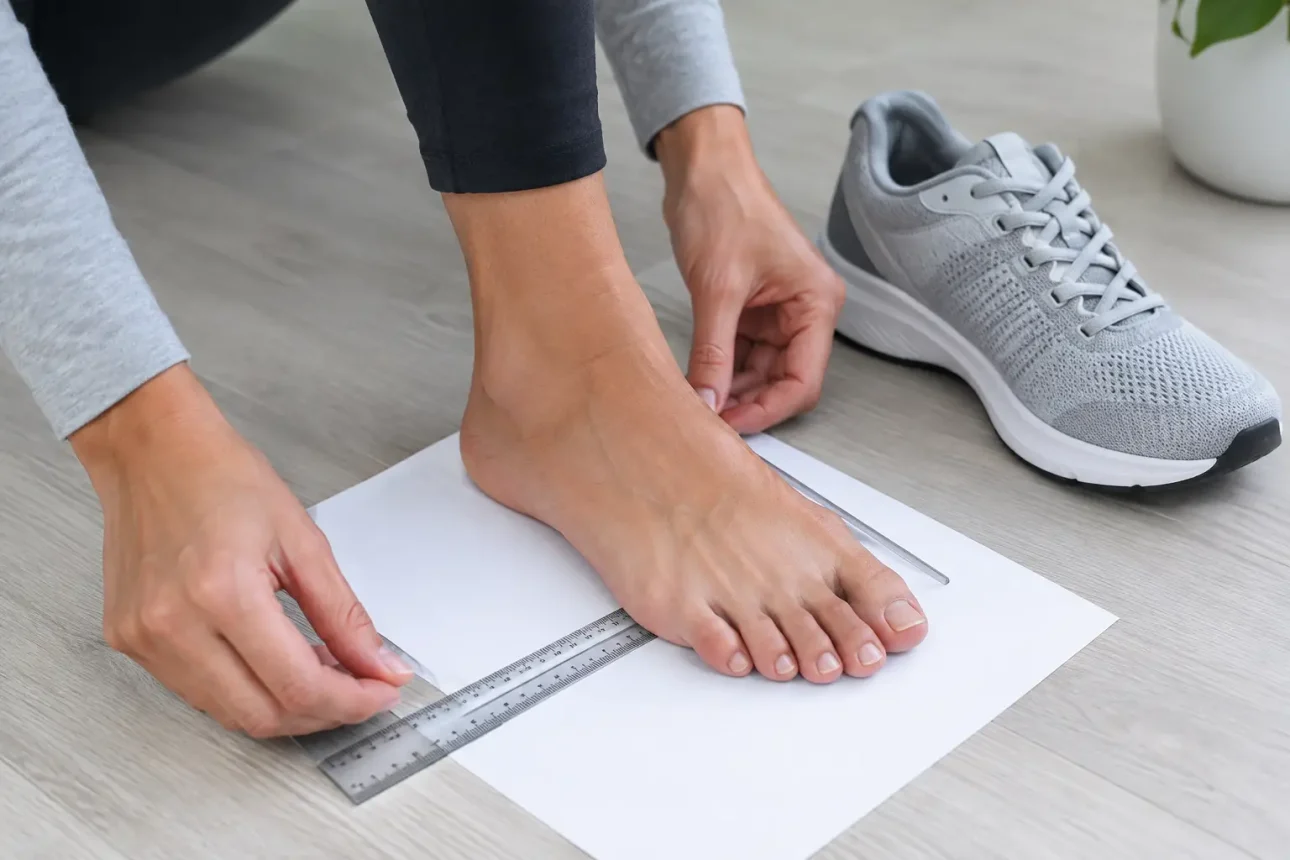
A size label is only useful if it matches your actual foot. To measure feet at home, you need about five minutes, a sheet of paper, a pen, a ruler, and a wall. Do it right and you avoid the usual problem: sneakers that felt fine for two minutes indoors, then started squeezing your toes by lunchtime.
We see it all the time. Someone buys the size they have worn for years, skips the measurements, and assumes every brand works the same. It doesn’t. Nike can feel narrow. New Balance often gives you more room. Hoka models can run long or snug depending on the shape. Your foot is the starting point, not the number printed inside an old pair.
Keep it simple. Grab a hard, flat floor, not carpet. You will need one sheet of paper bigger than your foot, a pen or pencil, a ruler with inches or centimeters, and the socks you normally wear with the shoes.
Wear running socks if you are measuring for running shoes. Wear the thicker socks you use for work or walking if that is what you are buying for. Measuring barefoot and then buying a shoe for thick socks is an easy way to get a fit that feels tight from day one.
Do the measurement later in the day if you can. Feet often spread and swell a little after walking, working, or standing around. A shoe that fits your morning foot can feel different at 5 p.m. The later measurement is usually the safer one, especially if you spend long days on your feet.
Put the paper flat against a wall. Stand on it with your heel lightly touching the wall. Keep your weight on both feet. This part matters. Sitting down or balancing on one leg can make your foot look shorter and narrower than it is.
Have someone mark the tip of your longest toe. If you are measuring yourself, keep the pen as upright as possible and make a small mark. Do not trace around your whole foot unless you are checking width too. A full outline can get messy fast and usually adds more guesswork than help.
Step off the paper and measure from the edge that touched the wall to the toe mark. That is your foot length. Write it down in centimeters and inches if your ruler shows both. Centimeters are often easier when you are comparing a measurement with a shoe size chart.
Then repeat the process with the other foot. Most people have one foot that is slightly longer. It might only be a few millimeters, but that is enough to matter in a close-fitting sneaker. Always use the larger foot measurement when choosing a size. Trying to make the bigger foot fit a smaller shoe is not worth it.
If you want a quick check, make the measurement twice. If the two numbers are noticeably different, reset the paper, stand naturally, and try again. A clean measurement beats a rushed one.
Length gets most of the attention, but width is where plenty of bad fits start. If the sides of your shoes bulge, your little toe gets rubbed, or you regularly loosen the laces all the way, measure your width too.
Stand on the paper as before and have someone mark the widest points of your foot. This is usually across the ball of the foot, near the base of your big toe and little toe. Measure the distance between those marks. Do both feet and use the wider result.
A width measurement will not always translate neatly into a letter like D or 2E, because brands build shoes differently. Still, it tells you whether you should stop forcing your foot into narrow-looking models. If you need room, look for styles offered in wide widths or sneakers with a naturally broader toe box.
Flat, slim lifestyle sneakers can look sharp, but they are not always kind to wide feet. If your day involves a lot of walking or standing, we would take extra toe room over a cleaner side profile every time.
Your foot length is not necessarily the exact inside length you need from a shoe. You need a little space in front of the longest toe so your foot can move as you walk or run.
For casual sneakers and everyday walking shoes, aim for roughly a thumb’s width of space at the front when you try the shoe on. For running shoes, a little extra room is often smart because feet can swell during longer runs. That does not mean sizing up blindly. Too much length lets your heel slide and can make the shoe feel clumsy.
The right amount depends on what you do in the shoes. A person walking to work and standing behind a counter all day needs comfort and toe space. Someone wearing sneakers mostly for short trips may prefer a closer fit. Neither choice is wrong. The problem is buying a tight shoe because it looks sleek, then wondering why you cannot wait to take it off.
Once you have your measurement, compare it with the size chart for the specific brand and model you want. Do not assume that a US 9 is exactly the same across every label. It rarely is.
Some brands are known for a snug, performance-style fit. Others build in more volume through the forefoot or heel. Even within one brand, a retro court sneaker and a cushioned running shoe can fit very differently. A Nike lifestyle shoe might feel narrow where a Brooks walking or running shoe feels more forgiving in the same labeled size.
Your current shoe can still be useful as a reference, but only if it fits well. Check the size tag, then measure the removable insole if there is one. Compare its length to your foot measurement. This gives you a real-world baseline instead of relying on a number you have repeated out of habit.
When you are between sizes, think about the shoe’s shape and your use. Go up if the model is narrow, you wear thicker socks, or you need it for long walks and runs. Stay closer to your measured size if the shoe already runs long or has a roomy upper. Reviews can help here, but your own measurements should lead the decision.
Measuring gets you close. Trying the shoes on properly tells you whether the choice was right. Put on both shoes, lace them the way you would actually wear them, and walk around indoors for a few minutes.
Your heel should feel secure without being pinned down. Your toes should not touch the front when you stand, walk, or roll onto the balls of your feet. The upper should hold your foot without digging into the sides. A little break-in is normal with some materials. Toe pressure, numbness, or hard rubbing are not things we would wait around to “break in.”
Pay attention to both feet. If one feels fine and the other feels crowded, trust the crowded foot. That is why we measure both in the first place.
Kids outgrow shoes faster than adults expect. Check their feet every few months, especially before a new school term, a sports season, or a growth spurt. Do the same wall-and-paper measurement, with the socks they will actually wear.
Avoid buying too big just to make a pair last longer. Extra growing room is fine. A shoe that is much too long can make walking awkward and give the foot less support. You are looking for sensible space up front, not a shoe that flops around.
The best sneaker is not always the flashiest one or the pair with the loudest reviews. It is the one that gives your toes room, keeps your heel steady, and still feels good after a normal day. Take five minutes to measure. Your feet do a lot of work. Buying the right size is the least we can do for them.