Cart
No products in the cart.
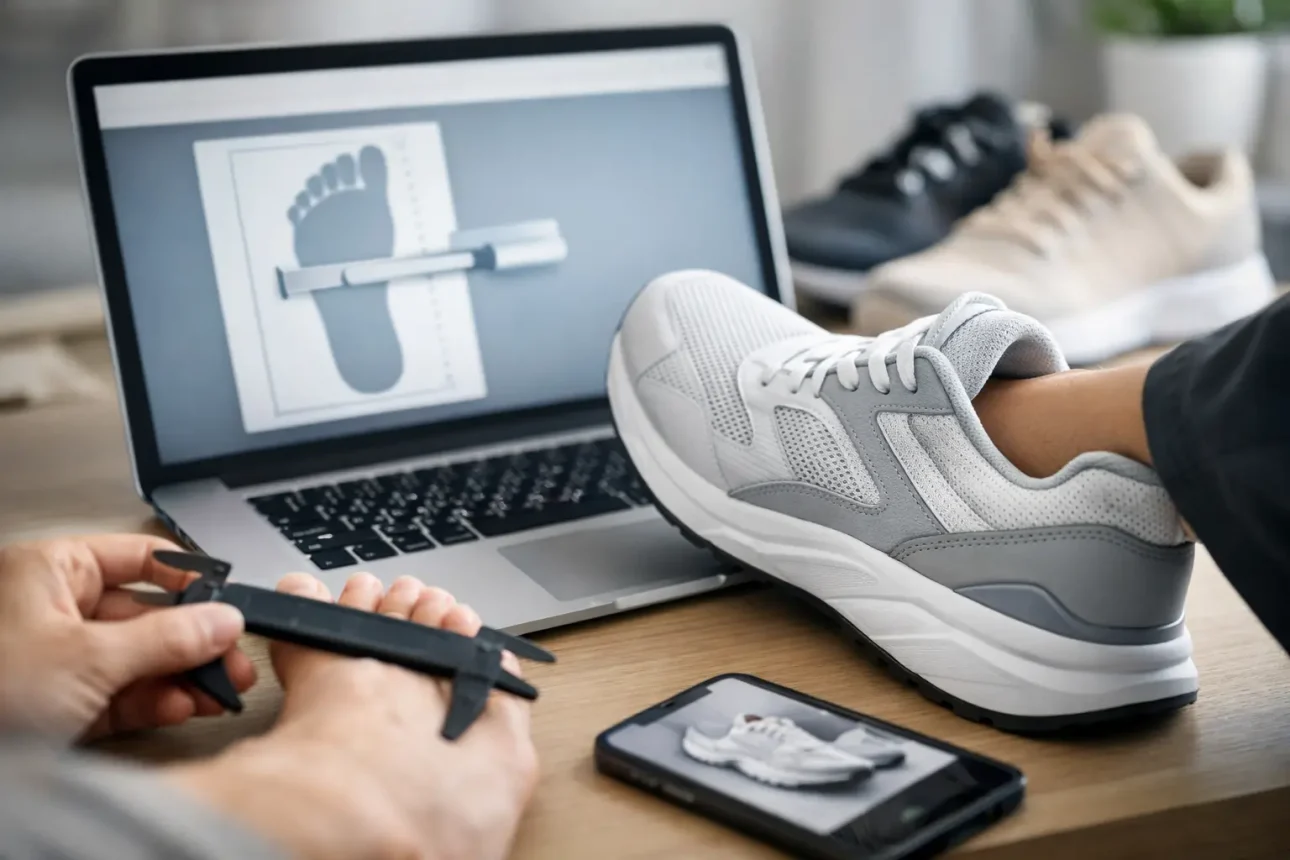
A sneaker size guide online can save you from the usual mistake: buying the size you always wear, then realizing your toes hit the front by lunchtime. Size on the box is only a starting point. Your foot shape, sock choice, and the brand all matter. What matters most is how your feet feel at 5pm, not how clean the shoe looked when you opened it.
We keep it simple. Measure your feet properly, check the chart for the exact brand, and leave enough room for the way you actually move. That takes a few minutes. Breaking in a pair that pinches your little toe takes much longer.
Do not guess from an old pair. Sneakers stretch, feet change, and different brands use different molds. Put on the socks you plan to wear with the shoes, stand on a piece of paper, and trace both feet. Keep the pen straight up and down. Then measure from the back of your heel to your longest toe.
Your longest toe may be your second toe. That is normal. Use the longer measurement, not the foot you assume is bigger.
Measure later in the day if you can. Feet tend to swell after walking, standing, commuting, or working a long shift. A shoe that feels fine at 8am can feel tight by the afternoon. If you are buying walking shoes, running shoes, or anything for all-day wear, this small detail is worth taking seriously.
For casual sneakers, aim for roughly a thumb’s width of space between your longest toe and the front of the shoe. You do not need a huge empty gap, but your toes should not touch the end when you stand or walk.
For running shoes, a little extra room is usually smart. Your foot moves forward as you run, especially downhill. A close fit can feel fast in the store and become miserable after a few miles. If you are between sizes, we would usually lean up for running, provided your heel stays secure.
A work shoe or walking sneaker sits somewhere in the middle. You want enough toe room for a full day, but not so much length that your foot slides around. Sliding leads to rubbing. Rubbing leads to blisters. No shoe is worth that.
Once you have a foot measurement, use the size chart shown for that specific brand or product. Look for the measurement in inches or centimeters first, then match it to the listed US size. Size labels such as 9, 10, or 11 are useful, but the length measurement is the part that gives you a real comparison.
Do not assume a men’s 9, women’s 9, and unisex 9 are interchangeable. They are not always built on the same scale. A unisex sneaker may be listed in men’s sizing, while a women’s version can run narrower through the heel and forefoot. Read the product details before picking a size.
When a chart gives a range and you land right on the edge, think about how you will use the shoe. Choose the smaller option if you have a narrow foot and want a close casual fit. Choose the larger option if you use thicker socks, have a wider forefoot, stand all day, or need room for running. It depends on the shoe, but squeezing into the smaller size rarely gets better with time.
This is where people get caught out. A size that feels right in one brand can feel noticeably different in another.
Nike lifestyle models can feel fairly narrow, particularly around the front of the foot. If you have a wide forefoot, do not force it because you like the color. Consider going up half a size if the model does not come in a wide option.
Adidas classics such as the Gazelle often have a low, close feel. They look sharp, but they are not the pair we would choose for a very wide foot. On the other hand, New Balance is often a safer place to start if width is your main issue, especially when the model is available in multiple widths.
ASICS, Brooks, Hoka, and On all make shoes that work well for walking and running, but their fits still vary by model. A Hoka Bondi has a different feel from an Arahi. A Brooks Ghost Max does not wrap the foot exactly like a Hyperion. Use the chart, then read the fit notes with the shoe’s purpose in mind.
A shoe can be the right length and still be wrong for your foot. Pay attention to width, heel hold, and the height of the upper over the top of your foot.
If the sides of your foot bulge over the midsole, or the upper feels tight across your smallest toe, you probably need more width. Going up a full size may create extra length without solving that problem. A wider version is better when available.
If your heel lifts with every step, the shoe may be too long, too wide at the heel, or simply the wrong shape for you. Before giving up on the pair, try relacing it with a runner’s loop. This uses the top eyelets to hold the heel more firmly. It can help with mild slipping, but it cannot turn a bad fit into a good one.
The top of the shoe matters too. People with a higher instep often feel pressure from laces even when the toe box is fine. Loosen the lower laces slightly or look for a roomier upper. Do not crank the laces down to stop a loose heel if the shoe is already pressing on the top of your foot. That is just trading one problem for another.
When your shoes arrive, try them indoors on a clean floor while you can still decide whether they are right for you. Wear the same socks you measured in. Stand, walk around the room, go up and down stairs if you have them, and pay attention to obvious pressure points.
Your toes should move without hitting the front. Your heel should stay mostly in place. The shoe should feel secure around the middle of your foot without numbness, tingling, or sharp pressure.
Do not expect every sneaker to feel pillow-soft straight out of the box. Some firmer shoes loosen slightly through the upper after a few wears. But the length will not change, and a tight toe box will not magically become spacious. If it hurts indoors, it will hurt more after a full day outside.
The biggest mistake is sticking to a number instead of fitting the foot. Your usual size is a useful clue, not a rule.
Another mistake is buying a performance shoe for looks alone. A flat, narrow sneaker may look good with jeans, but it is not our first pick if you walk 10 miles a day or work on concrete. Style matters. So does getting home without sore feet.
People also size down because they want the shoe to look smaller or feel snug. That is not how a good fit works. A secure shoe holds your heel and midfoot. It does not crush your toes.
Finally, do not judge fit while sitting down. Stand up. Put your full weight on both feet. That is when your foot spreads and shows you what the shoe is really doing.
At The Sneaker Base, we carry shoes for regular life: the commute, the long shift, the school run, the weekend walk, and the run you fit in when you can. The right pair is not always the trendiest one. It is the one you forget about while wearing it.
Use a sneaker size guide online as your first filter, not a final promise. Measure both feet, check the brand chart, account for width, and test the fit indoors. If a shoe needs you to talk yourself into it, skip it. The right size should feel easy from the first steps.